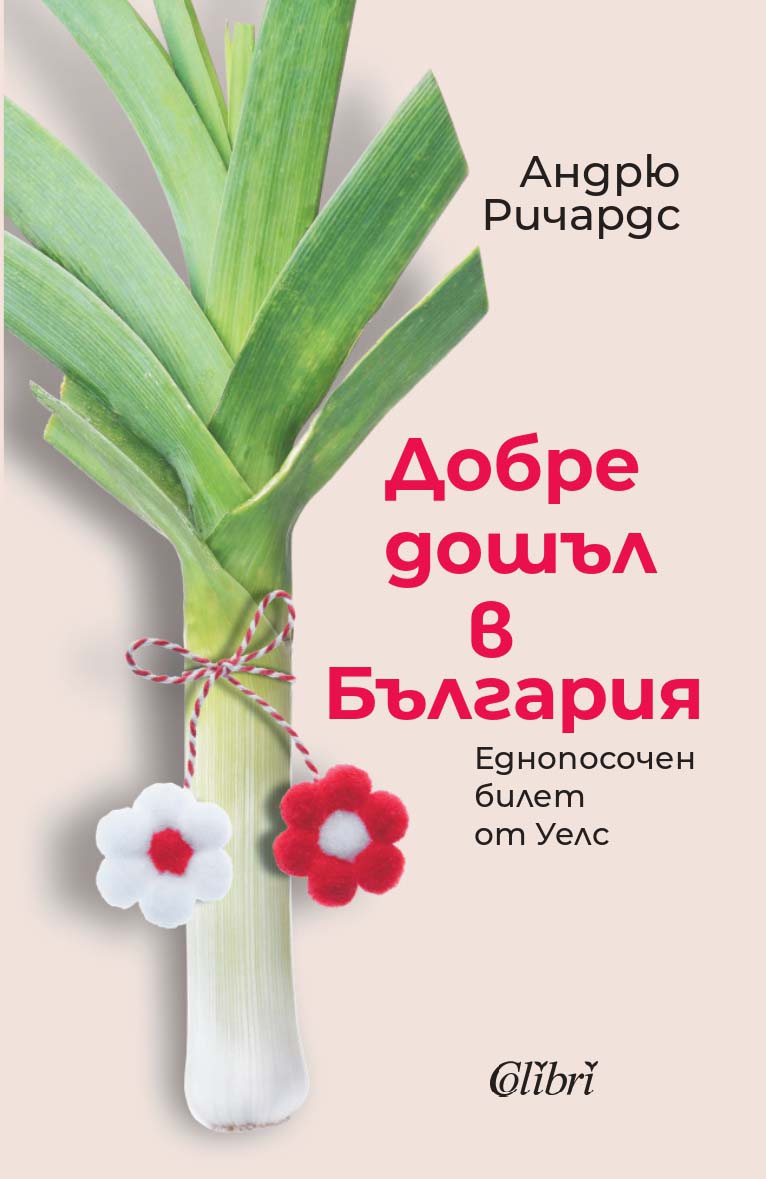
 Bulgarian version out now: Добре дошъл в България
I grew up in a pink house in a tiny village in Wales called Trap, or Trapp as it is spelt in Welsh. In Wales all the signs have to be written in both English and Welsh – the two official languages of Wales. I think when they were making the village sign for Trap they thought that they couldn’t just write ‘Trap’ twice, as that would look silly, so they decided to pop an extra ‘p’ on the end, maybe just to make the Welsh version look more sophisticated than the English. In Wales, we are always looking for ways to get one-up on our larger English neighbours.
When the council paint ‘SLOW’ on the road in big white letters they also have to paint the Welsh word for slow ‘ARAF’ straight after it. So if you understand Welsh as well as English you get told to slow down twice every time, which I think is much more effective for road safety. One of my English friends who visited Wales for the first time asked me, “What are these arafs that you need to slow down for? Is araf Welsh for giraffe and do you think we’ll see one?”
To describe Trap as a village would be somewhat overstating it. There was a grand total of nine houses. I counted them, it didn’t take that long. I suspect it was called Trap because it was actually a kind of trap. The centre of the village was surrounded by steep green hills on every side. It was like a big, green bowl. The houses were scattered around the walls of the bowl and at the bottom was where all roads down the numerous hillsides converged. If you visited Trap on foot or on bike the only way out was up long and very steep hills.
Marking the centre of the village was a stone bridge, wide enough for one car to pass at a time and where every couple of years a lorry would get stuck, bringing some much-needed excitement to the inhabitants. The stone bridge ran over a small, meandering river. On one side of the bridge was a ‘sub’ post office with a red telephone booth and a red post box outside. The sub-post office was actually where Janice The Post Office, as she was known, lived.
It was very common in Wales for everyone, regardless of age, to have a nickname. This would normally be formed from either the person’s profession being tacked on to the end of their name or by adding a location marker so everyone would be clear who you were talking about. Apart from Janice The Post Office there was also Ann Brown Hill. Ann lived on a hill, although so did we all, so the name inventors, whoever they were, had to distinguish it somehow and decided on brown as opposed to all the other hills around, which were green. Jones The Milk and Evans The Bread could be found in every Welsh village and ours was no exception. My favourite name in our village, however, was Mrs. Thomas The Wine. I don’t know if she was aware that this was how the whole village referred to her. She was a schoolteacher and a well-respected, bespectacled, well-dressed older lady. I found her and her name fascinating as a kid. I loved imagining her getting home and secretly glugging back glass after glass.
The post office wasn’t your normal post office. It was just Janice’s house. Janice The Post Office had simply turned half her living room into a place selling stamps and envelopes. She had also somehow got a red post box installed in her front garden. So when you visited the post office you’d have to walk through her front garden, open the front door of her house, which I was always a bit uncomfortable about, and step over the shoes on the floor and past the drying umbrellas before making your way into the ‘post office’. You’d often walk in to buy a stamp and catch Janice watching Coronation Street with her dinner on her lap. She’d say “hia, love”, put her food down, wipe her mouth quickly with her hand, give the stamp a lick, slap it on your envelope and say “there you go, love. Say hi to mam!”
On the other side of the bridge in the centre of the village was a black and white pub called the Cennen Arms. The landlord was a particularly shy and quiet speaking man called Idris. Idris had the classical monk haircut. Completely bald on top but with a line of generous, thick black hair on the sides and back. All the farmers from the surrounding area converged on the pub every evening. They drank 9 pints as if it was orange juice before jumping in their open back pickup trucks, 2 or 3 sheepdogs aboard, and driving home through the dark, narrow country lanes.
We had a black and white Welsh sheepdog too even though we didn’t live on a farm. Our sheepdog’s name was Twm and my father bought him as a 4-week-old puppy from a local farm. Twm loved being outdoors and would wander round the village as he pleased. Now and again, even as a tiny puppy, he’d go missing. We’d look high and low only to notice that all the sheep in the neighbouring field were neatly standing in one corner all bunched up together.
Even though Twm had never been trained to round up sheep he would jump the garden fence at any opportunity. He’d pin his ears back and run like the wind round the perimeter of the huge field - he would never run in a straight line anywhere. Keeping as low to the ground as possible he would circle round the sheep and make them all stand together in the naughty corner. He never knew what to do with the sheep after rounding them up, he’d just sit and watch them. Of course, the farmer didn’t like Twm doing this. He said the pregnant sheep can get scared and there’s a risk of losing the lambs. So, it was my job as a young boy to jump over the fence, squelch through muddy fields and chase after Twm in the lashing Welsh rain.
From the Cennen Arms pub, and in fact from anywhere in the village, you had wonderful views of Carreg Cennen Castle. Perched imposingly atop a limestone crag and at the top of the highest hill in the village, the castle dated back to the 13th century.
I had been up to the castle a couple of times as a kid and climbed over the walls, scrambled through the dungeons and over the wooden bridge, but in truth I was never really interested in old castles. I presume it’s where we fought the English a few hundred years ago and probably lost. If we’d won there would have been a huge sign saying so and every school child in Wales would have had to visit it at least three times every year and write school projects on the famous victory. There wasn’t any sign or school children to be seen so most likely a miserable defeat to those English people again.
There was no public transport in or out of the village, just your occasional coach load of Japanese tourists passing through to visit the castle. It was peaceful, charming and idyllic. But not for a young boy. I didn’t care about the castle, I was too young to go to the pub, and the old red post box and red telephone booth were just reminders of how time was passing both me and the village by. I stood in the garden with my nose pointed upwards and wondered where the planes with their fluffy white trails were going. Dad said they turned left at the castle on their way to America.
In the evenings I’d sit on the window ledge in my bedroom and watch the wind blowing endless sheets of rain diagonally across the green village hills. Tears of frustration and boredom just added an extra blur to the blanket of grey outside. I could see warm yellow lights on in the pub where people were busy being merry and enjoying themselves. I longed to be out in the world, enjoying life too. Anywhere. I just wanted to get out of Trap.